
Court Pace Index: How We Measure Court Speed (And Match the ATP)
How we approximate court speed from match data and calibrate it to the ATP's numbers.
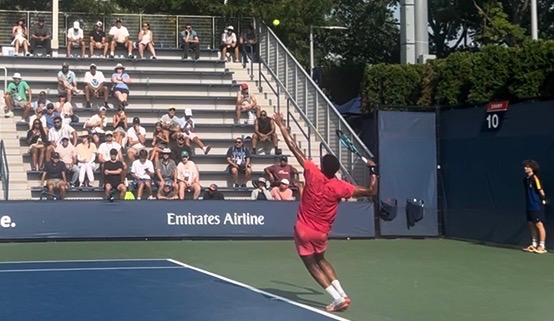
Indian Wells plays slower than Miami. Cincinnati and the US Open are both hard courts, but the ball bounces differently.
The ATP publishes a Court Pace Index for some events—a number that tells you how fast or slow a court plays. We wanted that for every tournament on our site, including the ones the ATP doesn't publish. So we built our own.
How Do You Even Measure Court Speed?
You don't stick a speedometer on the court. You infer it from what happens in the matches.
If a court is fast, servers should do better than usual. If it's slow, they struggle to hold. We compare what players actually did at the tournament to what we'd expect from their career averages. More aces than expected? Court favors servers. Fewer break points saved? Returners get more cracks. We average this across every match at the event.
Aces — For each match we know each player's career ace rate. Multiply by serve points to get expected aces, compare to actual. Ratio above 1.0 = faster court. Below 1.0 = slower. Same idea for break point defense: if players save more break points than their career norm, the court is helping servers.
We pack this into two numbers per tournament and move on.
Calibrating Against the ATP
We have our signals. We don't have a physical CPI. So we calibrate against the ATP's published data.
The ATP reports an Overall Speed Rating for many tournaments each year. We match that to our tournaments by name and year, then run a regression. The formula boils down to: our ace signal + our break-point signal + surface adjustments (clay is slower, grass faster, etc.) = a CPI on the same scale as the ATP's (roughly 18–50, higher = faster).
We use ordinary least squares. The fit isn't perfect—court speed is noisy—but it's good enough to rank tournaments and flag fast vs slow. R² around 0.64, RMSE around 3.5. We apply the same calibration to WTA; the coefficients come from ATP only, but the logic works for both tours.
Where You'll See It
On our tournament calendar and individual tournament pages. Same labels as the ATP: Very Fast, Fast, Average, Slow, Very Slow. Here are the three Grand Slams from 2025, one per surface:
So when a big server thrives in NYC or struggles in Indian Wells, you can see why. Court speed isn't everything, but it matters.
We also rate players with Elo—worth reading next if you care how the match predictions on the site are built.